
Water-Injected vs Dry Oil-Free: The Core Difference
Both technologies deliver compressed air with no oil contamination. That is where the similarity ends. A dry oil-free screw compressor achieves oil-free output through precision-machined rotors that spin without contact, coated with PTFE or other non-stick materials and kept apart by external timing gears. There is no injection medium inside the compression chamber — no oil, no water. The consequence is that all compression heat must be managed externally, which is why dry oil-free machines require two compression stages with an intercooler between them and a separate aftercooler at the discharge. A water-injected oil-free screw compressor takes a fundamentally different approach: purified water floods the compression chamber continuously, absorbing heat the instant it is generated, sealing the rotor clearances, and lubricating the rotor surfaces simultaneously. The result is near-isothermal compression in a single stage — a physical efficiency gain that cannot be replicated by adding stages or improving intercooling on a dry machine.
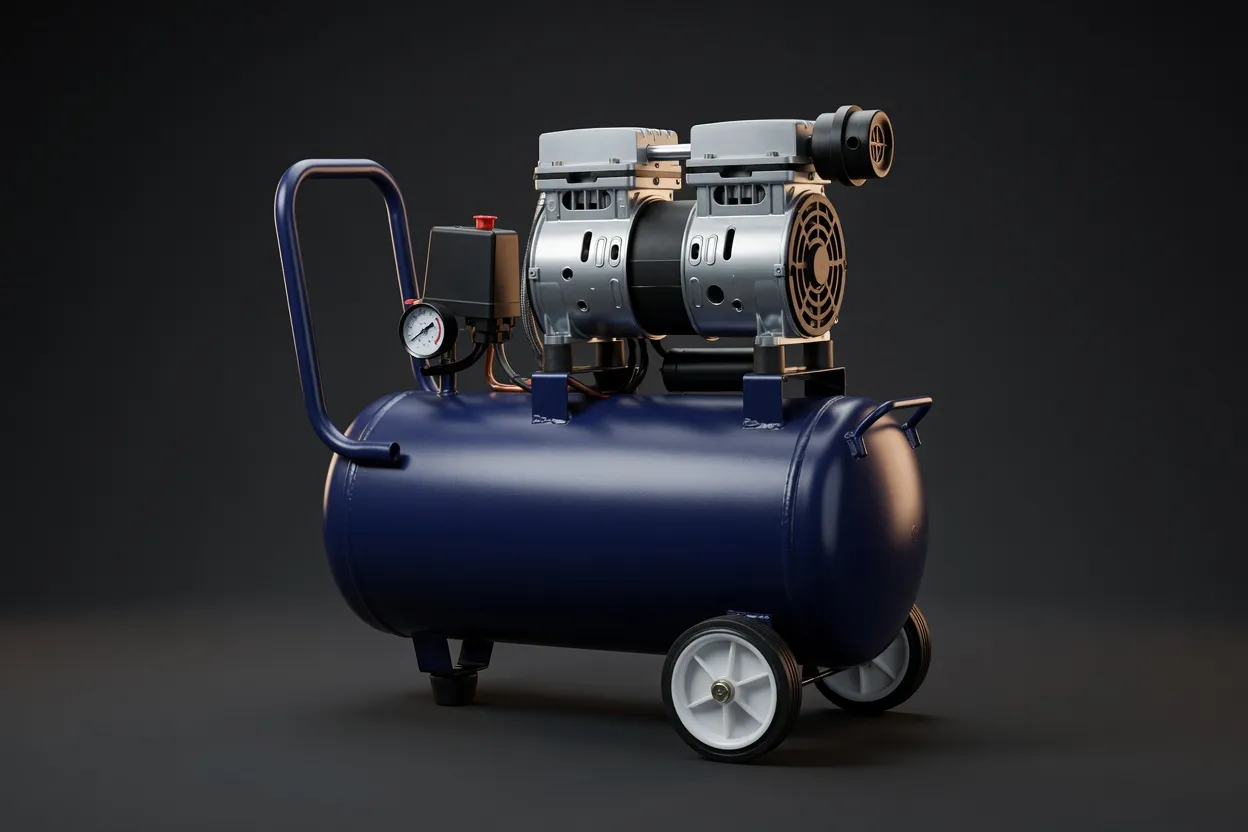
Compression Physics: Why Single-Stage Water Injection Wins on Energy
Thermodynamic theory establishes that isothermal compression — where temperature remains constant throughout — requires the least work of any compression process. Dry oil-free compression approaches adiabatic conditions because there is nothing inside the chamber to absorb heat; temperature rises steeply with pressure, and this heat represents wasted energy that must be removed downstream. Water injection drives the process toward isothermal because water’s specific heat capacity is roughly four times higher than air. Every litre of injected water absorbs a substantial quantity of compression heat before it separates from the air stream in the downstream water separator. Published field data consistently shows water-injected screw compressors consuming 12–20% less energy than equivalent-capacity two-stage dry oil-free machines at the same output pressure, measured at the package inlet terminals. Over a ten-year service life running 6,000 hours per year, that difference represents a very large sum on the electricity bill — often exceeding the total original purchase price difference between the two technologies.
Discharge Temperature: A Practical Difference That Matters
Discharge temperature is not just a specification number — it drives downstream equipment selection, installation cost, and compressed air quality. Dry oil-free compressors typically deliver air at 160–220°C from the compression element, requiring a large aftercooler to bring the temperature down to a level where a refrigeration dryer can function. Water-injected machines discharge at 60–80°C directly from the compression element. This lower discharge temperature means a smaller, cheaper aftercooler (or sometimes none at all), simpler pipework downstream, and a refrigeration dryer that operates within its designed temperature window without oversizing. For installations in confined spaces — common in pharmaceutical plant rooms and food factory utility areas — the reduced heat rejection from a water-injected package is a genuine installation advantage, not a marginal detail.
Head-to-Head Comparison Table
| Criterion | Water-Injected Oil-Free | Dry Oil-Free |
|---|---|---|
| Compression stages | Single stage | Two stages + intercooler |
| Discharge temperature | 60–80°C | 160–220°C |
| Specific energy (kW/m³/min) | ~5.5–6.2 | ~6.5–7.5 |
| Timing gears required | No | Yes |
| Aftercooler required | Minimal / optional | Mandatory, large |
| Water treatment system | Required (RO unit) | Not required |
| Noise level (typical) | 62–72 dB(A) | 68–78 dB(A) |
| ISO 8573-1 Class 0 | Achievable at package outlet | Achievable with filtration |
| Water quality dependency | High (RO water critical) | None |
Where Dry Oil-Free Still Holds Ground
Honesty matters in technical comparisons. Dry oil-free compressors retain genuine advantages in specific circumstances. First, where water quality management is genuinely problematic — remote sites without reliable RO water supply, or facilities without the maintenance discipline to monitor circuit pH and conductivity regularly — the absence of a water circuit removes a significant failure mode. Second, at very high working pressures above 13 bar, water-injected technology faces engineering challenges that dry oil-free multi-stage designs handle more comfortably. Third, in some geographies, the installed service network for dry oil-free machines is better established, reducing downtime risk if a component fails outside normal working hours. These are real considerations, not theoretical ones. For most industrial applications in food, pharmaceuticals, electronics, and textiles — where a water supply and RO treatment are routine and energy costs are significant — the water-injected vs dry oil-free decision consistently favours water injection on a total cost of ownership basis.
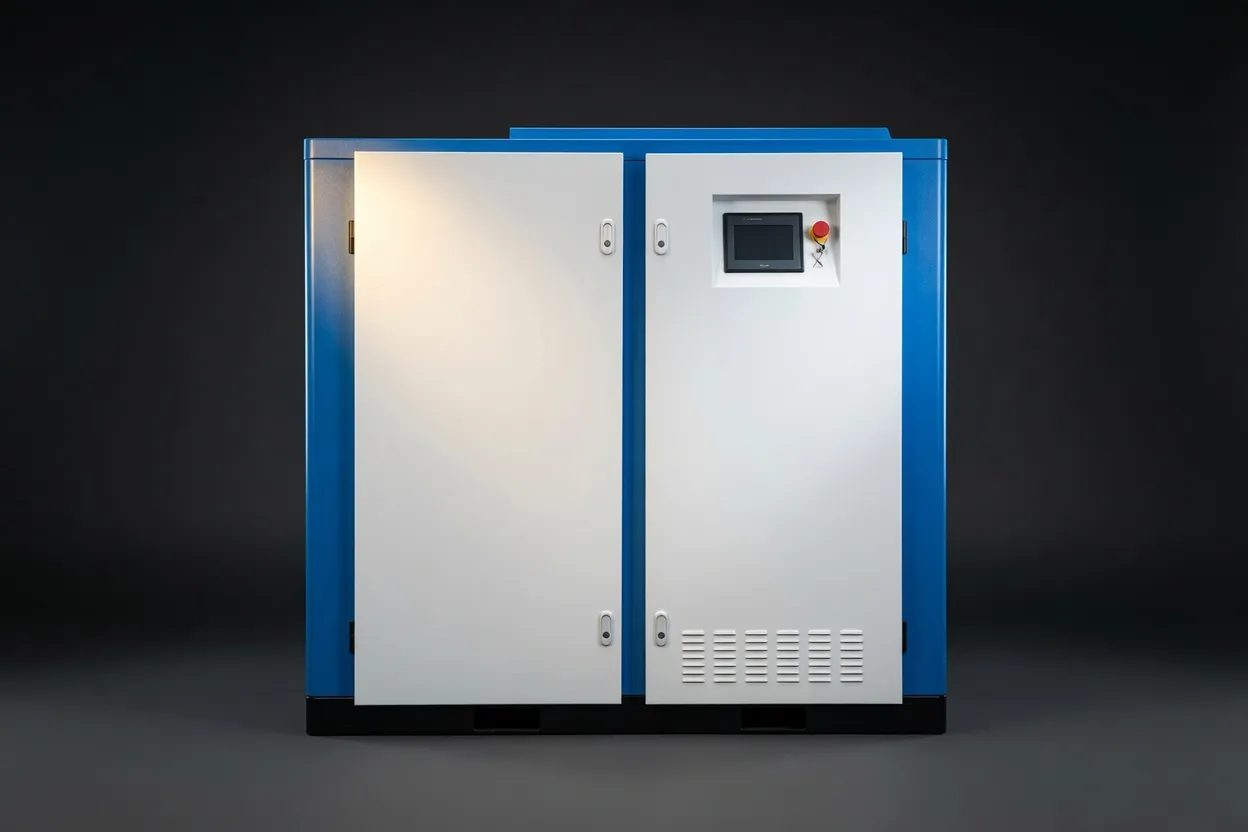
Noise, Vibration, and Plant Environment
Water acts as a natural damper inside the compression chamber. The water film between the rotor faces and housing absorbs pressure impulses that in a dry machine transmit directly as mechanical noise and vibration. The practical result is that water-injected screw compressors typically operate 5–8 dB(A) quieter than comparable dry oil-free machines. In a pharmaceutical or food facility where the compressor room sits adjacent to production areas, this is not a trivial difference — 6 dB(A) represents a halving of perceived loudness. Lower vibration also means less transmission of noise through building structures and reduced long-term fatigue on pipework connections and instrument fittings.
Maintenance Profile: What Each Technology Demands
Neither technology is maintenance-free, but the maintenance tasks differ significantly in nature and frequency.
- Water filter: every 2,000–4,000 hrs
- Water circuit flush: every 4,000–6,000 hrs
- pH & conductivity check: quarterly
- Shaft seals: every 16,000–20,000 hrs
- Rotor inspection: every 20,000–30,000 hrs
- Timing gear oil change: every 4,000–8,000 hrs
- Intercooler inspection: annually
- Rotor coating check: every 12,000–16,000 hrs
- Aftercooler service: annually
- Bearing replacement: every 20,000–25,000 hrs
Dry oil-free machines require timing gear lubrication management — a task that introduces oil into the machine even though it stays outside the compression chamber. Gear oil degradation, seal wear around the gear housing, and intercooler fouling are the most common failure modes. Water-injected machines have no timing gears to lubricate, but the water circuit demands consistent quality discipline. The penalty for neglecting water quality in a water-injected machine — scale, corrosion, eventual rotor seizure — is more severe than the penalty for delayed timing gear service on a dry machine. This is why water quality management should be treated as a critical maintenance task, not an optional housekeeping item.
Which One Should You Choose?
The answer depends on three primary variables: energy cost significance, water management capability, and working pressure requirement.
- Electricity costs are significant (most facilities)
- Demand varies across shifts (VSD option available)
- Facility runs a water supply and can install RO
- Low noise is important near production areas
- Working pressure is below 13 bar
- Reliable RO water supply is unavailable
- Working pressure exceeds 13 bar
- Remote location with limited maintenance support
- Existing service contracts cover dry machines
- Water circuit monitoring cannot be maintained
Frequently Asked Questions
Need Help Deciding Between Water-Injected and Dry Oil-Free?
Our application engineers at Hangzhou Ever Power review your site conditions and demand profile — and give you a straight answer, not a sales pitch.
Hangzhou Ever Power Air Compressor Co., Ltd. · Shenhua Road, Hangzhou 310031, China · +86 13083988828