
Three Jobs, One Medium — Why Water Works Where Oil Cannot
In any rotary screw compressor, the compression element faces three simultaneous engineering challenges: the rotors must be lubricated to prevent surface wear, the rotor clearances must be sealed to prevent internal leakage of high-pressure gas back to the low-pressure inlet, and the heat generated by compression must be removed fast enough to prevent thermal damage and maintain acceptable discharge temperature. In an oil-injected screw compressor, mineral oil handles all three tasks simultaneously. In a dry oil-free screw compressor, precision-machined rotor profiles and external timing gears handle the mechanical separation, while two-stage compression with an external intercooler manages the thermal problem — but no internal medium addresses sealing or lubrication. In a water-injected oil-free screw compressor, purified water steps into the role that oil plays in a conventional machine, performing all three functions without introducing any oil contamination into the compressed air. Understanding exactly how water achieves each of these roles explains both the performance advantages and the specific design requirements of this technology.
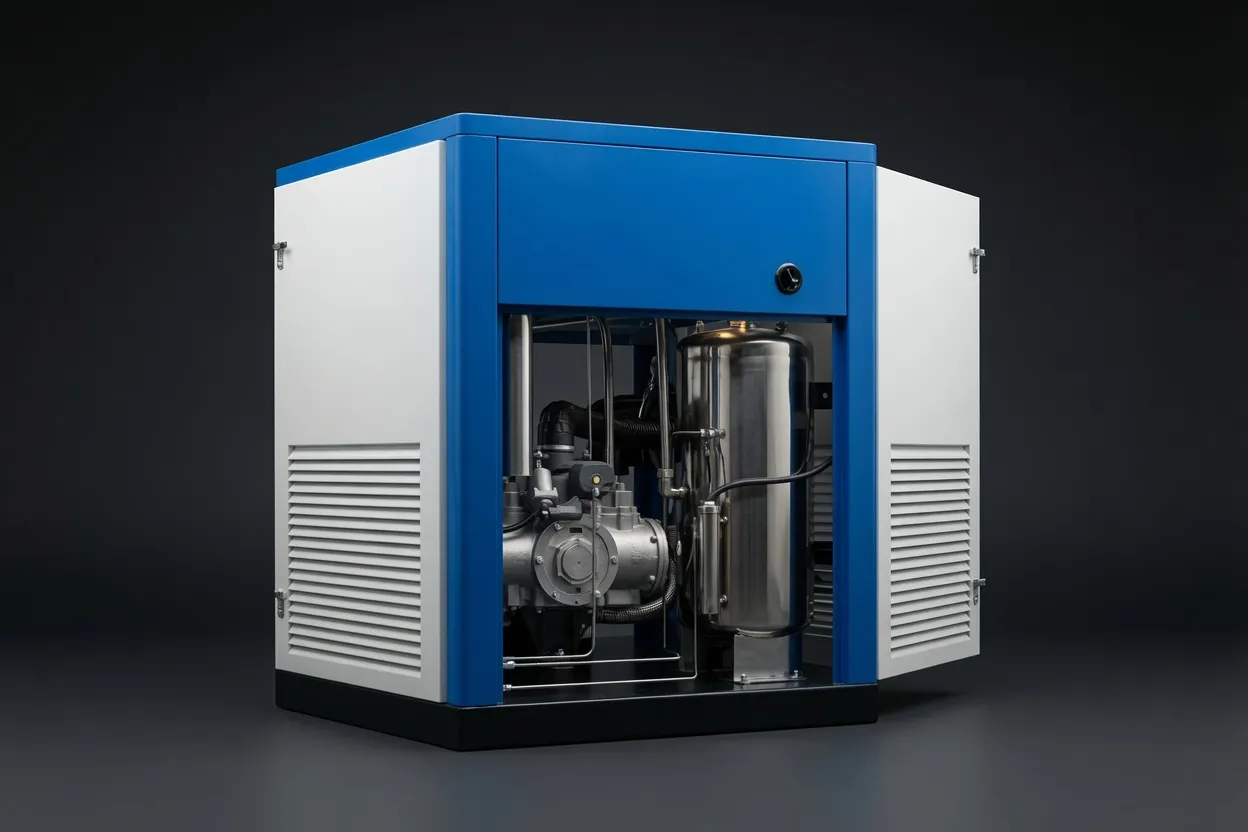
Role 1 — Cooling: Absorbing Compression Heat at the Point of Generation
Cooling is the most thermodynamically significant of water’s three roles in the compression chamber. As the rotor pair reduces the volume of trapped gas, pressure and temperature rise simultaneously. Without any internal heat absorber, temperature in a single-stage screw element compressing air to 8 bar would reach 200–230°C at the discharge port — a temperature that would immediately degrade any rotor surface coating, damage elastomeric seals, and make single-stage compression to useful industrial pressures impractical.
Injected water enters the compression chamber as a fine mist of droplets, maximising the surface area available for heat transfer. Water’s specific heat capacity of 4,186 J/kg·K — more than twice that of mineral oil and approximately four times that of air — allows each kilogram of injected water to absorb a substantial quantity of compression heat before it reaches the water separator. The combined effect of high specific heat, large droplet surface area, and continuous injection throughout the compression stroke keeps discharge temperature in the range of 60–80°C — cool enough for single-stage compression to be thermally safe, and cool enough for the downstream refrigeration dryer to operate well within its design envelope.
Role 2 — Sealing: Closing the Gap Between Rotors and Housing
Screw compressor volumetric efficiency depends on how well the compression chambers are sealed — specifically, how little high-pressure gas leaks back through the clearance gaps between the rotor lobes and the compressor housing, and between the male and female rotor flanks, to the low-pressure inlet side. In an oil-injected machine, oil’s relatively high viscosity fills these micron-scale clearance gaps, forming a dynamic liquid seal that significantly reduces internal leakage. In a dry oil-free machine, there is no sealing medium — the rotor profile must be machined to very tight tolerances, and the rotors kept separated by external timing gears, to achieve acceptable volumetric efficiency without contact.
Water, despite its low viscosity relative to oil, provides meaningful sealing in a water-injected screw compressor through a different mechanism: the continuous high-volume flow of water through the clearance gaps maintains a dynamic liquid barrier that gas must force through to leak back. The water flow rate is high enough that any leakage path is continuously flushed by incoming water, preventing gas channels from developing. This water-sealing effect allows water-injected rotors to operate with slightly larger clearances than dry oil-free rotors — which in turn means the rotors do not need to be held apart by external timing gears, eliminating a significant mechanical component and its associated maintenance requirements.
Role 3 — Lubrication: Protecting Rotor Surfaces Without Oil
The third role of water injection is lubrication — preventing the direct metal-to-metal contact between the rotor surfaces and the compressor housing that would otherwise cause rapid wear. This is the role where water’s physical properties most clearly differ from oil, and where rotor material selection becomes critical. Water’s dynamic viscosity at operating temperature (approximately 0.4–1.0 mPa·s at 40–80°C) is far lower than that of mineral oil (15–50 mPa·s at comparable temperatures). A thin film of water cannot support the same hydrodynamic bearing load as an oil film of equivalent thickness.
How Rotor Material Design Compensates for Water’s Lower Viscosity
The engineering solution is not to make water behave like oil — it is to design rotors that do not need the same lubricating film thickness. High-performance water-injected compressor rotors use stainless steel cores with polymer-ceramic composite surface coatings engineered to provide low friction even in the boundary lubrication regime where the water film breaks down under load. These coatings — typically PEEK (polyetheretherketone) or similar high-performance polymers filled with ceramic particles — have very low coefficients of friction against themselves and against the compressor housing material, preventing wear even during brief periods of rotor contact. The water in the compression chamber still provides hydrodynamic lift during normal operation, reducing contact frequency and duration. The coating handles the moments when that film breaks down. Together, water flow and rotor coating achieve service lives of 40,000–80,000 hours between major rotor inspections in well-maintained installations.
| Function | Water-Injected | Oil-Injected | Dry Oil-Free |
|---|---|---|---|
| Cooling | Water (60–80°C out) | Oil (80–100°C out) | External intercooler |
| Sealing | Dynamic water flow | Oil viscosity film | Precision rotor tolerances |
| Lubrication | Water + polymer coating | Oil hydrodynamic film | No contact (timing gears) |
| Air purity | Class 0 at outlet | Requires filtration | Class 0 achievable |
| Timing gears needed | No | No | Yes |
Why Water Quality Is Non-Negotiable for All Three Roles
All three roles — cooling, sealing, and lubrication — depend on the water in the injection circuit maintaining its physical and chemical properties within specified limits. Hard water containing dissolved calcium and magnesium carbonate deposits scale on rotor surfaces, reducing cooling effectiveness by insulating the rotor from the cooling water film. Scale in the water separator reduces separation efficiency. Acidic condensate — formed when CO₂ from the inlet air dissolves in the circuit water, producing carbonic acid — attacks stainless steel and polymer rotor coatings, reducing lubrication effectiveness and increasing corrosion. Biological growth in the water circuit changes viscosity and pH, again affecting both cooling and sealing performance. Reverse osmosis treatment to below 50 µS/cm conductivity, combined with pH monitoring and periodic circuit flushing, maintains the water in a condition where it can perform all three functions reliably throughout the compressor’s service life. This is not a maintenance preference — it is an engineering requirement built into the design of the water injection system.
Frequently Asked Questions
Discuss Your Application with Our Engineers
Our technical team can advise on rotor material selection, water quality requirements, and water circuit design for your specific application and site conditions.
Hangzhou Ever Power Air Compressor Co., Ltd. · Shenhua Road, Hangzhou 310031 · +86 13083988828