
What ISO 8573-1 Actually Measures and Why It Matters
Compressed air leaving a compressor is never perfectly clean. It carries contaminants introduced from three sources: the inlet air drawn into the machine (atmospheric dust, water vapour, microorganisms), the compression process itself (heat, condensation, oil in oil-injected systems), and the distribution system (pipe scale, joint compound, condensate). ISO 8573-1 is the international standard that defines quality classes for each contaminant category — providing a common language for specifying, purchasing, and verifying compressed air purity across industries and geographies. The standard covers three primary contaminant groups: solid particulates (measured as particle count per cubic metre by size class), water content (measured as pressure dew point in °C or liquid water carry-over in mg/m³), and oil content (measured as total oil concentration in mg/m³, including aerosol, liquid, and vapour fractions). Each group has its own class scale from Class 1 (most stringent) upward. Class 0 sits above Class 1 — it is not a standard class in the conventional sense but a provision for applications requiring purity beyond what Class 1 defines, with the specification agreed between user and supplier.
The Full ISO 8573-1 Oil Classification Table
| Oil Class | Total Oil Content (mg/m³) | Typical Application |
|---|---|---|
| 0 | As specified — below Class 1 detection limits | Pharma, food contact, semiconductor |
| 1 | ≤ 0.01 mg/m³ | Critical process air |
| 2 | ≤ 0.1 mg/m³ | General industrial process |
| 3 | ≤ 1.0 mg/m³ | General workshop air |
| 4 | ≤ 5.0 mg/m³ | Pneumatic tools, non-critical |
| X | > 5.0 mg/m³ | Heavy general industry |
Why Class 0 Is Not Simply “Very Low” Oil — It Is a Different Category
Class 1 in the ISO 8573-1 oil scale requires total oil content at or below 0.01 mg/m³ — already extremely low by any practical standard. Class 0 goes further: it specifies that the supplier and user must agree on a more stringent limit specific to the application, and that this limit falls below what Class 1 instruments can reliably detect. In practice, this means total oil content at the package outlet is effectively zero — not just undetectable by the measurement method used in Class 1 testing, but undetectable by the most sensitive instruments available. For a water-injected oil-free screw compressor, achieving Class 0 is a direct consequence of the compression technology: there is no oil anywhere in the compression system to carry over into the output air. The challenge is not engineering the oil out — it is proving, through third-party accredited testing, that the output air contains no measurable oil across the full range of operating conditions.
How Water Injection Achieves Class 0 — The Technical Pathway
Class 0 at the Bare Compressor vs Class 0 at the Package Outlet — A Critical Distinction
One of the most important questions to ask any supplier making a Class 0 claim is: where exactly is Class 0 being measured? A bare compressor discharge — the outlet of the compression element before the water separator and downstream filtration — will never achieve Class 0 because it carries bulk water droplets. The meaningful Class 0 measurement is at the complete package outlet: after the water separator, after the coalescent filter, and after the refrigeration dryer. This is the point where compressed air enters the distribution pipework and ultimately reaches the process. Some suppliers quote Class 0 test results from prototype units tested under controlled laboratory conditions different from continuous industrial operation. A credible Class 0 claim must be supported by third-party testing under steady-state operating conditions at rated load, with the measurement point clearly identified as the complete package outlet.
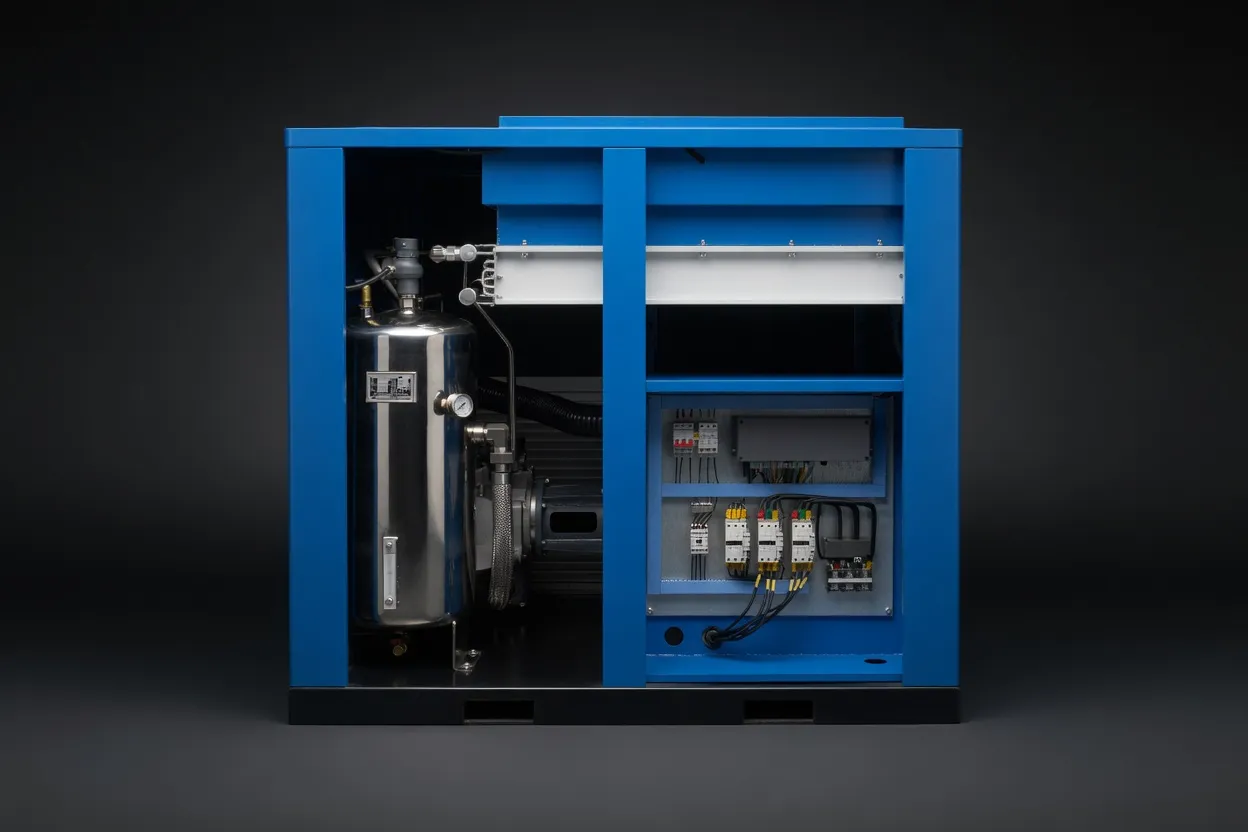
At Hangzhou Ever Power, our water-lubricated oil-free screw air compressors are tested to ISO 8573-1 Class 0 at the complete package outlet under continuous rated operating conditions. The test report from the accredited laboratory is supplied with every order as standard documentation — not an optional add-on. Customers requiring it for pharmaceutical, food, or electronics compliance audits receive the complete test evidence pack including the measurement point specification, test conditions, and laboratory accreditation details.
What the Class 0 Test Actually Measures
ISO 8573-2 through ISO 8573-9 define the test methods for each contaminant category in ISO 8573-1. For oil content, the relevant test methods measure three separate fractions that together constitute total oil content. Oil aerosol — liquid oil droplets suspended in the air — is captured on a glass fibre filter and measured gravimetrically. Oil vapour — oil in the gas phase, below its condensation temperature — is captured on activated carbon and measured by solvent extraction and gas chromatography. Total oil content is the sum of these two fractions plus any liquid oil measured separately. For a water-injected screw compressor with no oil in the system, all three measurements return values below the detection limit of the respective test method — which is the physical reality underlying the Class 0 designation. The test report should list the actual measured values for each fraction, not simply state “Class 0 achieved,” so that the numerical results are on record for audit purposes.
Particulate and Dew Point Classes — The Complete Air Quality Picture
ISO 8573-1 Class 0 for oil is one component of a complete compressed air quality specification. A full specification for a pharmaceutical or food plant typically combines oil Class 0 with a particulate class (typically Class 1 or 2) and a humidity class (typically Class 2 or 3, corresponding to a pressure dew point of -20°C to -40°C). A water-injected compressor package achieves the oil component through the compressor technology itself. The particulate class is achieved through the downstream filtration system. The humidity class is achieved through the refrigeration or desiccant dryer. All three components must be specified, verified, and maintained to deliver air that meets the full quality requirement — not just the oil component in isolation. Omitting any one class from the specification is the compressed air equivalent of leaving a door open in a cleanroom.
Frequently Asked Questions
Request the Class 0 Test Report for Your Application
Hangzhou Ever Power supplies the full ISO 8573-1 Class 0 accredited test report with every compressor order. Contact us to receive a sample documentation pack before purchasing.
Hangzhou Ever Power Air Compressor Co., Ltd. · Shenhua Road, Hangzhou 310031 · +86 13083988828