
The “Oil-Free” Label: What It Means and What It Does Not
Walk through any industrial compressor catalogue and you will find the term “oil-free” applied to machines with very different designs and very different actual air purity levels at the outlet. The label describes a feature of the compression technology — specifically that no lubricating oil is used inside the compression chamber — but it says nothing definitive about the oil content of the compressed air produced. A dry oil-free screw compressor with worn shaft seals leaking gear oil vapour into the compression chamber is technically “oil-free by design” but may be delivering measurable oil into the air stream. An oil-injected machine with a freshly replaced, properly specified activated carbon adsorber can deliver air with lower measurable oil content than a poorly maintained dry oil-free machine. The only statement that carries meaningful weight is not “oil-free compressor” but “ISO 8573-1 Class 0 verified at the package outlet under continuous operating conditions, confirmed by third-party accredited test report.” Everything else is a description of design intent, not a measurement of what the machine actually delivers.
Why Water Injection Provides Structural Oil-Free Assurance
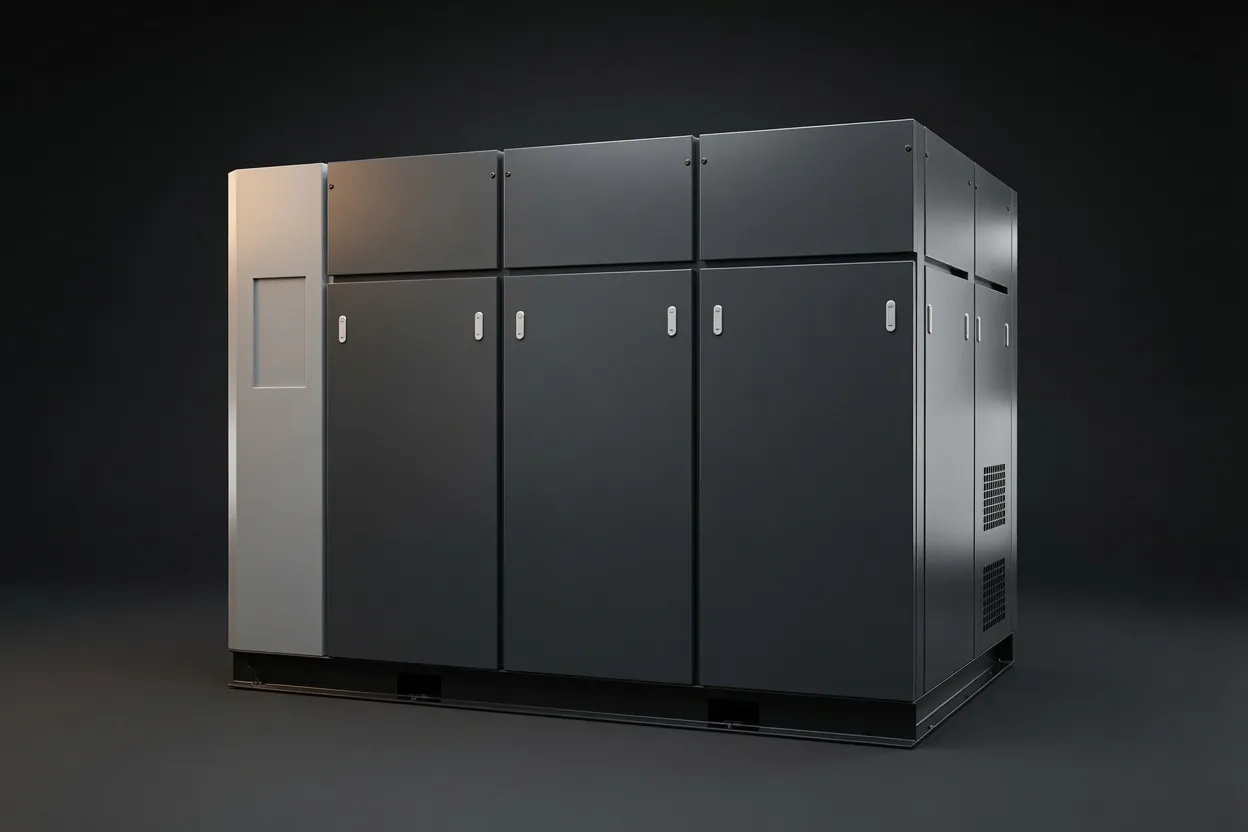
A water-injected oil-free screw compressor achieves oil-free output through what engineers call a structural guarantee — one that is built into the physical architecture of the machine rather than dependent on a consumable component performing correctly. There is no lubricating oil anywhere in the compression system: no oil reservoir, no oil pump, no oil circuit, no oil seals between an oil-containing space and the compression chamber. The only medium that contacts both the rotors and the compressed air is purified water. This means that even in a degraded maintenance state — with an overdue water filter, a slightly worn water pump, or a partially blocked injection nozzle — the oil content of the output air remains zero, because there is no oil in the system to carry over. The water-injected design eliminates not just oil contamination but the entire contamination pathway that makes oil contamination possible in other technologies.
This structural assurance is what distinguishes water-injected oil-free technology from both dry oil-free and oil-injected alternatives in the context of regulatory compliance. For a pharmaceutical quality manager preparing for an FDA inspection, a food safety manager conducting a BRC audit, or an electronics plant running a cleanroom qualification, the ability to state “no oil exists in the compressed air system” is qualitatively different from “oil is filtered out by maintained consumable components.” The first is an architectural fact. The second is a maintenance-dependent claim. Both can achieve Class 0 in practice — but only one removes the contamination pathway entirely.
Oil-Free Claims Compared Across Technologies
| Criterion | Water-Injected | Dry Oil-Free | Oil-Injected + Filters |
|---|---|---|---|
| Oil in compression system | None | Timing gear oil only | Yes — in chamber |
| Oil contamination pathway | Eliminated | Shaft seal leakage risk | Active — filter dependent |
| Class 0 assurance type | Structural (design) | Design + seal integrity | Maintenance dependent |
| Carbon adsorber required | No | No (usually) | Yes — mandatory |
| Risk if maintenance overdue | Water quality / particulate | Gear seal degradation | Oil enters air stream |
| ISO 8573-1 Class 0 achievable | Yes — inherent | Yes — with care | Yes — when maintained |
What the Water Circuit Introduces: Honest Assessment
Being rigorous about “truly 100% oil-free” requires acknowledging what the water circuit does introduce, even though oil is not among its contributions. The compressed air leaving a water-injected compressor after the water separator carries residual water vapour and fine water droplets that must be removed by downstream drying and filtration. The water itself — if circuit quality management fails — can carry dissolved CO₂, trace mineral deposits from RO membrane breakthrough, or biological matter from circuit contamination. None of these are oil, and none threaten ISO 8573-1 Class 0 oil compliance. But they can affect particulate class and dew point class compliance, which is why the complete compressed air quality specification covers all three contaminant categories — not just oil.
A properly maintained water-lubricated oil-free screw compressor with a functioning downstream treatment train delivers compressed air that is genuinely 100% oil-free, well within particulate Class 1–2, and at a pressure dew point well below the process requirement. The combination of oil-free compression technology and appropriate downstream treatment is the complete answer to the question — not the compressor alone, and not the filters alone.
How to Confirm “Truly Oil-Free” Before Committing to a Purchase
Frequently Asked Questions
Receive the Full Oil-Free Verification Package
Contact Hangzhou Ever Power for the complete ISO 8573-1 Class 0 test report, ISO 9001 certificate, and material compliance documentation for your compliance audit.
Hangzhou Ever Power Air Compressor Co., Ltd. · Shenhua Road, Hangzhou 310031 · +86 13083988828