
What Timing Gears Are and Why Dry Oil-Free Machines Need Them
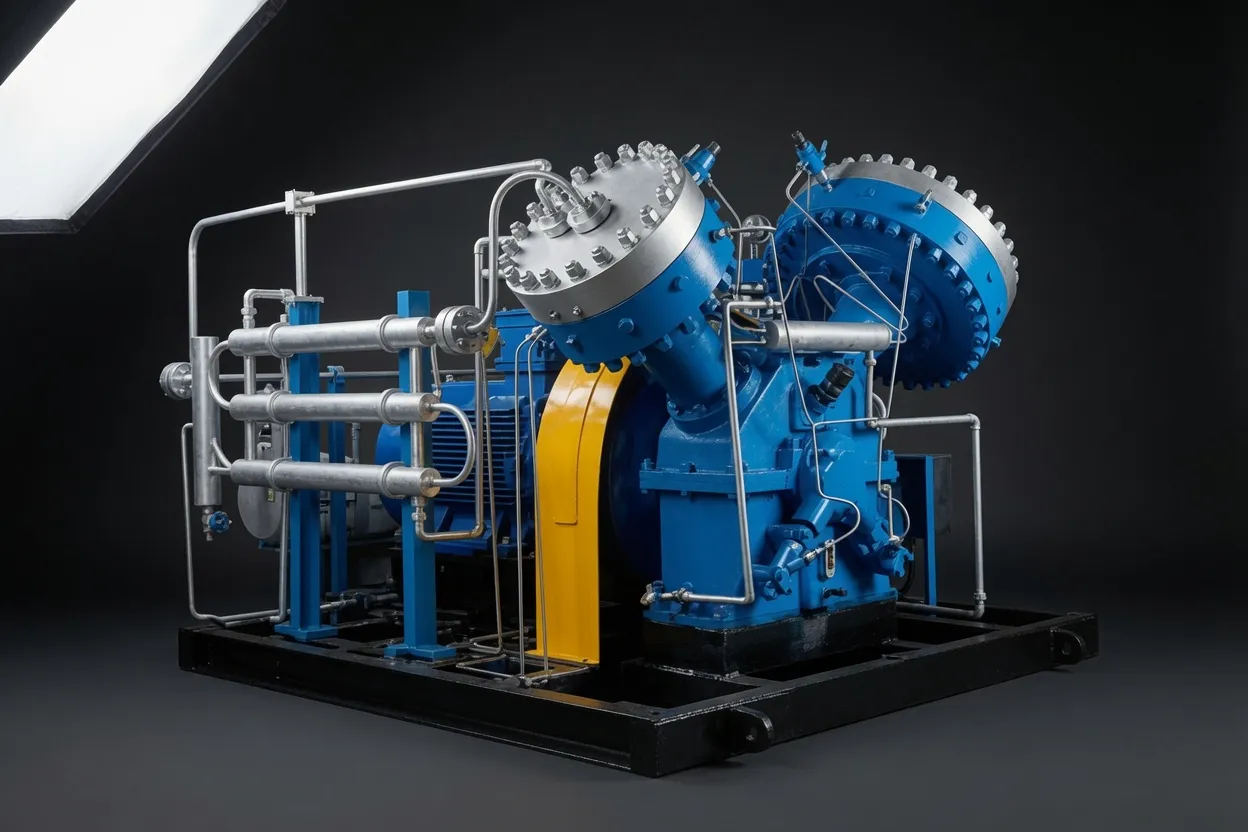
In a rotary screw compressor, two helical rotors — one male and one female — intermesh to trap and compress gas as they rotate. For the machine to work correctly without rotor-to-rotor contact, the two rotors must maintain precise angular synchronisation throughout every revolution. In an oil-injected screw compressor, the oil film between the rotors transmits driving torque from the male rotor to the female and simultaneously lubricates the contact surfaces, keeping the rotors apart and synchronised. In a dry oil-free screw compressor, there is no liquid medium between the rotors — the clearance gap is intentionally kept as small as possible for sealing, but rotor surfaces never contact each other. Without oil to transmit drive and synchronise rotation, a separate mechanical system must maintain rotor timing: the timing gear set. Timing gears are a pair of precision-machined external gears, one mounted on each rotor shaft, that mesh outside the compression chamber and keep the rotors in exact angular relationship regardless of the torque variations and thermal expansions the rotors experience during operation.
The Engineering Cost of Timing Gears
Timing gears are not a minor add-on — they represent a significant mechanical subsystem with real cost and maintenance implications. The gear set must be manufactured to very high precision, typically AGMA Class 11–13, because any backlash or profile error transmits directly as angular position error between the rotors. Even small angular errors cause intermittent rotor contact, leading to rapid wear of the rotor surface coatings and generating metal particles that contaminate the compressed air. The gears require their own lubrication system — a separate oil circuit with its own pump, filter, cooler, and oil reservoir. This oil circuit must be maintained independently of the compression circuit. Oil seals isolate the gear housing from the compression chamber, but these seals wear over time and can allow gear oil vapour to migrate into the compression chamber — a contamination pathway that, while small, means dry oil-free machines require careful monitoring to confirm that Class 0 air purity is actually being maintained at the package outlet over the machine’s service life.
Timing gear maintenance is one of the significant service cost items on a dry oil-free compressor. Gear oil changes are required every 4,000–8,000 hours. Gear wear inspection and adjustment require skilled technicians. Gear replacement — when tooth wear eventually degrades timing accuracy — is a major overhaul item. None of these costs and maintenance activities exist in a water-injected machine.
How Water Injection Eliminates the Need for Timing Gears
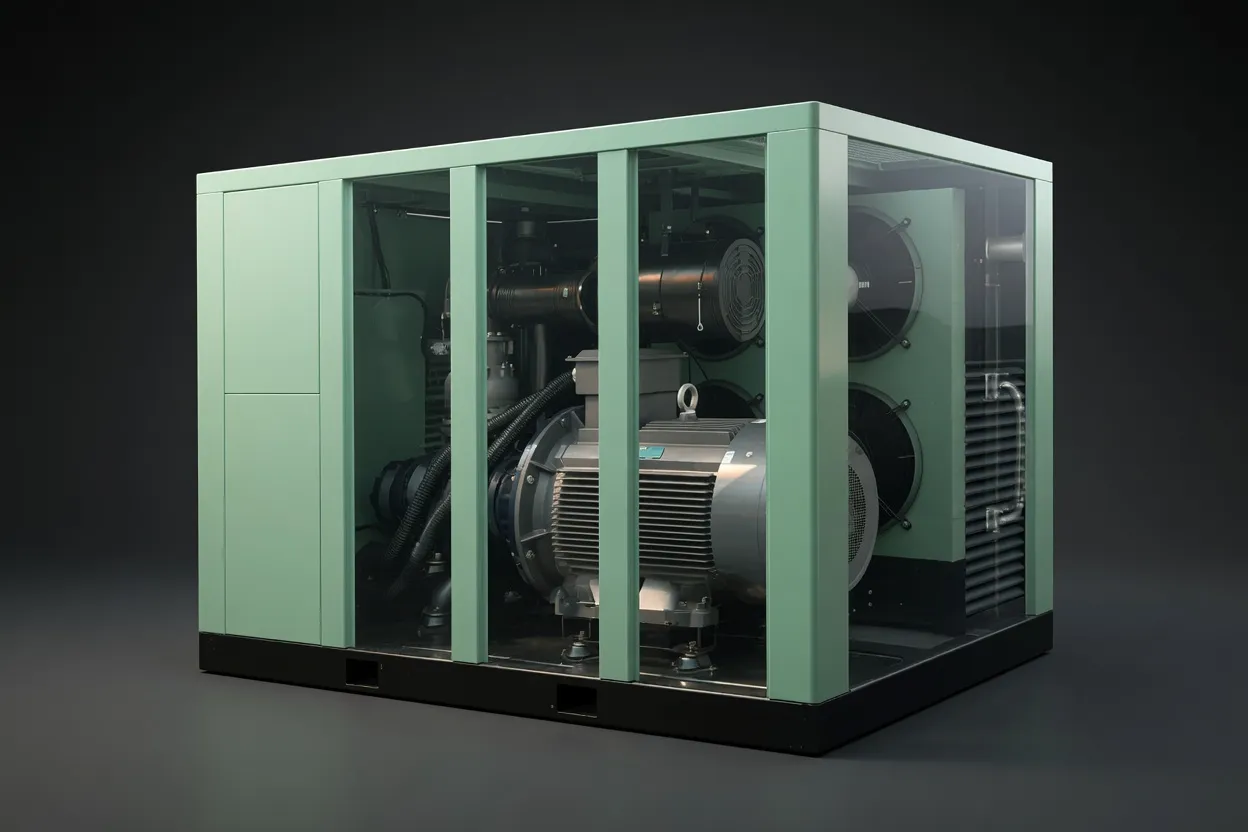
A water-injected oil-free screw compressor solves the rotor synchronisation problem through a fundamentally different mechanism. Water injected into the compression chamber at high flow rate forms a continuous liquid medium between the rotor flanks. This water film serves several synchronisation functions simultaneously. First, it transmits drive torque from the male rotor to the female rotor through hydrodynamic pressure — the same way an oil film transmits torque in an oil-injected machine. Second, it lubricates the rotor surfaces, preventing the rapid abrasive wear that would occur if the rotors made dry metal-to-metal contact. Third, it acts as a damping medium that absorbs the micro-scale angular variations caused by gas load fluctuations during the compression cycle, smoothing the velocity profile of the driven rotor.
The result is that the water film, combined with the polymer-ceramic rotor surface coatings designed to operate in water-lubricated conditions, provides sufficient synchronisation without external mechanical timing. The rotors can operate with slightly larger clearance gaps than dry oil-free machines — which further reduces the precision manufacturing burden and the risk of contact under thermal expansion — while the water seals those larger gaps more effectively than air alone would.
What Disappears When Timing Gears Are Removed
Timing Gears vs Water Film: A Direct Comparison
| Aspect | Timing Gears (Dry Oil-Free) | Water Film (Water-Injected) |
|---|---|---|
| Synchronisation mechanism | Mechanical gear mesh | Hydrodynamic water film |
| Lubrication requirement | Dedicated gear oil circuit | RO water circuit |
| Oil contamination risk | Possible via shaft seal wear | None — no oil in system |
| Service interval (sync system) | 4,000–8,000 hr oil change | 2,000–4,000 hr water filter |
| Major overhaul item | Gear set replacement | Rotor seal / bearing |
| Noise contribution | Gear mesh adds 3–5 dB(A) | Water damping reduces noise |
The Noise Reduction Benefit of Removing Timing Gears
Timing gear mesh generates a characteristic high-frequency tonal noise — the gear whine familiar from gearboxes. In a dry oil-free compressor running at 3,000–6,000 rpm rotor speeds, gear mesh frequencies fall in the 1–5 kHz range, which is within the most sensitive range of human hearing and within the range of strict workplace noise regulations. This gear noise is a persistent feature of dry oil-free machines that cannot be fully suppressed by acoustic enclosures without restricting cooling airflow. Water-lubricated oil-free screw compressors have no timing gears to produce this tonal component, and the water film inside the compression chamber actively damps the pressure pulsations that generate broadband compression noise. The combined result is typically 5–8 dB(A) lower total sound power level compared to a dry oil-free machine of equivalent capacity — a difference that is immediately audible and that significantly reduces the acoustic treatment requirements of the compressor room.
Frequently Asked Questions
See How Simplified Maintenance Reduces Your Total Cost
Our engineers can prepare a maintenance cost comparison between your current dry oil-free compressor and an equivalent water-injected model from Ever Power.
Hangzhou Ever Power Air Compressor Co., Ltd. · Shenhua Road, Hangzhou 310031 · +86 13083988828