
Compression Thermodynamics: The Three Theoretical Processes
To understand near isothermal compression, it helps to first understand what it is being compared against. Thermodynamics defines three idealised compression processes. Isothermal compression keeps gas temperature constant throughout the process — temperature rises generated by compression work are removed instantly as they occur, requiring the least theoretical energy of any compression pathway. Adiabatic compression allows no heat exchange with the surroundings — all compression work converts directly to temperature rise, requiring the most energy. Polytropic compression sits between these extremes, describing the real-world behaviour of most practical compressors, where some heat is exchanged but not enough to maintain constant temperature. Every real industrial compressor operates somewhere on the polytropic spectrum. The closer a compression process gets to isothermal, the less energy it consumes for the same output pressure and flow.
What Makes Compression “Near Isothermal” in Practice
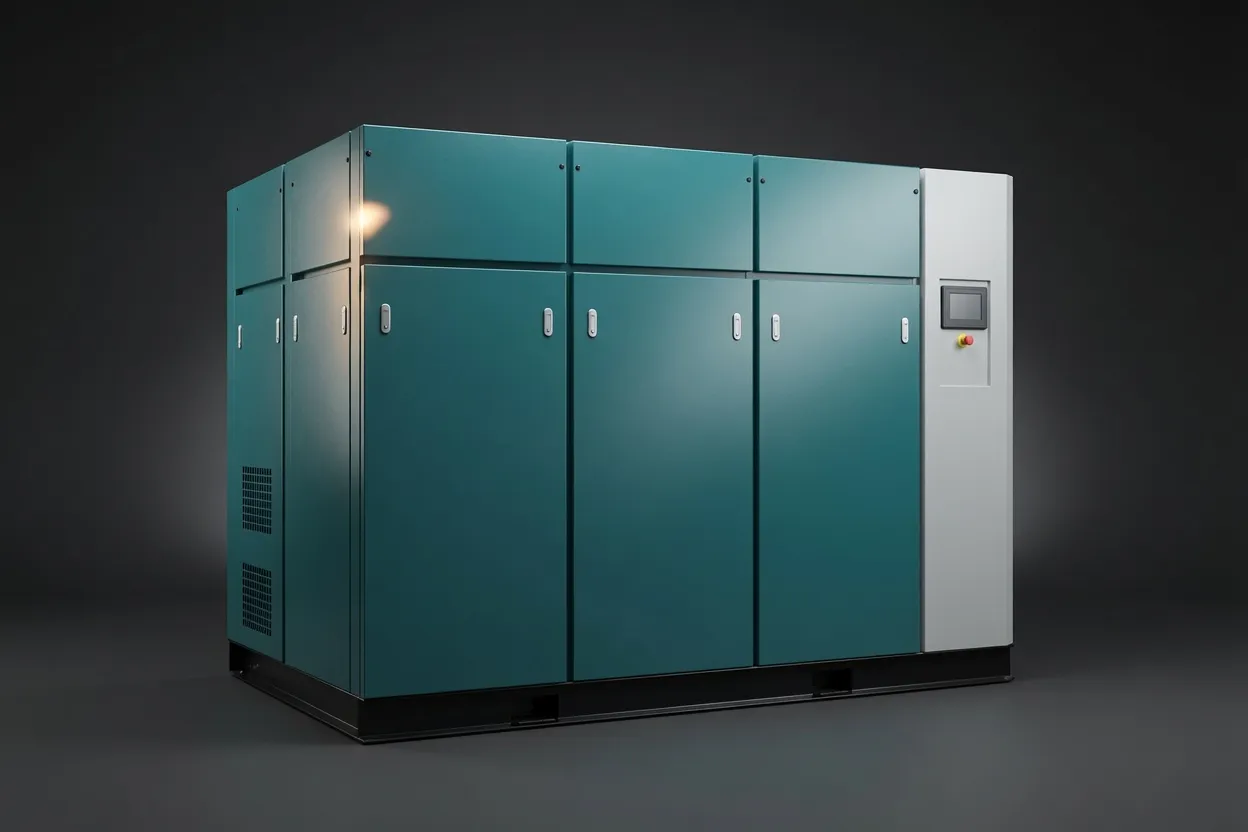
True isothermal compression is physically impossible in a machine operating at useful speeds — removing heat fast enough to prevent any temperature rise would require an infinitely large heat transfer surface. Near isothermal compression is the engineering approximation: a process in which temperature rise during compression is dramatically reduced compared to adiabatic compression by introducing a high-capacity heat absorber directly into the compression chamber. In a water-injected oil-free screw compressor, that heat absorber is purified water. Water’s specific heat capacity is approximately 4,186 J/kg·K — roughly four times higher than the specific heat of air at constant pressure. When water is injected at high flow rates into the compression chamber, it absorbs the heat generated by compression almost as fast as that heat is produced. The temperature of the gas-water mixture rises far less steeply than it would in a dry compression process, keeping the thermodynamic pathway close to the isothermal ideal.
The practical result is measurable: a water-injected screw compressor delivering air at 7–10 bar g typically discharges at 60–80°C from the compression element. A dry oil-free screw compressor reaching the same discharge pressure without an injection medium typically discharges at 180–220°C — requiring two compression stages with an intercooler between them simply to manage the temperature rise that water injection eliminates in a single stage. This compression temperature difference is not cosmetic; it represents a fundamental difference in the quantity of work the machine must perform to deliver the same compressed air output.
The Physics Behind the Energy Saving
The energy required to compress a gas from inlet pressure P₁ to discharge pressure P₂ depends directly on the compression pathway. For isothermal compression, the theoretical specific work is:
Where P₁ = inlet pressure, V₁ = inlet volume, ln = natural logarithm
For adiabatic compression, the specific work is higher by a factor that depends on the heat capacity ratio (γ) of the gas — for air, γ ≈ 1.4, meaning adiabatic compression requires approximately 15–25% more work than isothermal compression at typical industrial pressure ratios of 7–10. Water injection does not achieve perfect isothermal compression, but it brings the polytropic index of the real compression process significantly closer to 1.0 (isothermal) than the 1.4 of true adiabatic compression. Published measurements on water-injected machines consistently show polytropic indices in the range of 1.05–1.15, compared to 1.3–1.38 for equivalent dry oil-free machines. This is the physical source of the 12–20% energy saving that water-injected compressors demonstrate in independent comparative testing.
| Compression Type | Polytropic Index (n) | Discharge Temp (7 bar) | Relative Energy |
|---|---|---|---|
| Isothermal (ideal) | n = 1.00 | 20°C (inlet temp) | 100% (baseline) |
| Water-injected screw | n ≈ 1.05–1.15 | 60–80°C | ~108–115% |
| Dry oil-free (2-stage) | n ≈ 1.30–1.38 | 160–220°C | ~125–135% |
| Adiabatic (ideal worst) | n = 1.40 (air) | ~230°C | ~140% |
Why Single-Stage Is Sufficient When Compression Is Near Isothermal
Dry oil-free compressors require two compression stages to reach 7–10 bar because the temperature rise in the first stage — unchecked by any internal cooling medium — drives discharge temperature so high that attempting to continue compression in the same element would cause thermal damage to rotor coatings and housing seals. The intercooler between stages rejects this heat externally, cooling the gas before it enters the second stage. This works, but it adds mechanical complexity, increases the footprint of the installation, adds a service item (the intercooler), and consumes additional energy to drive the intercooler fan or cooling water pump.
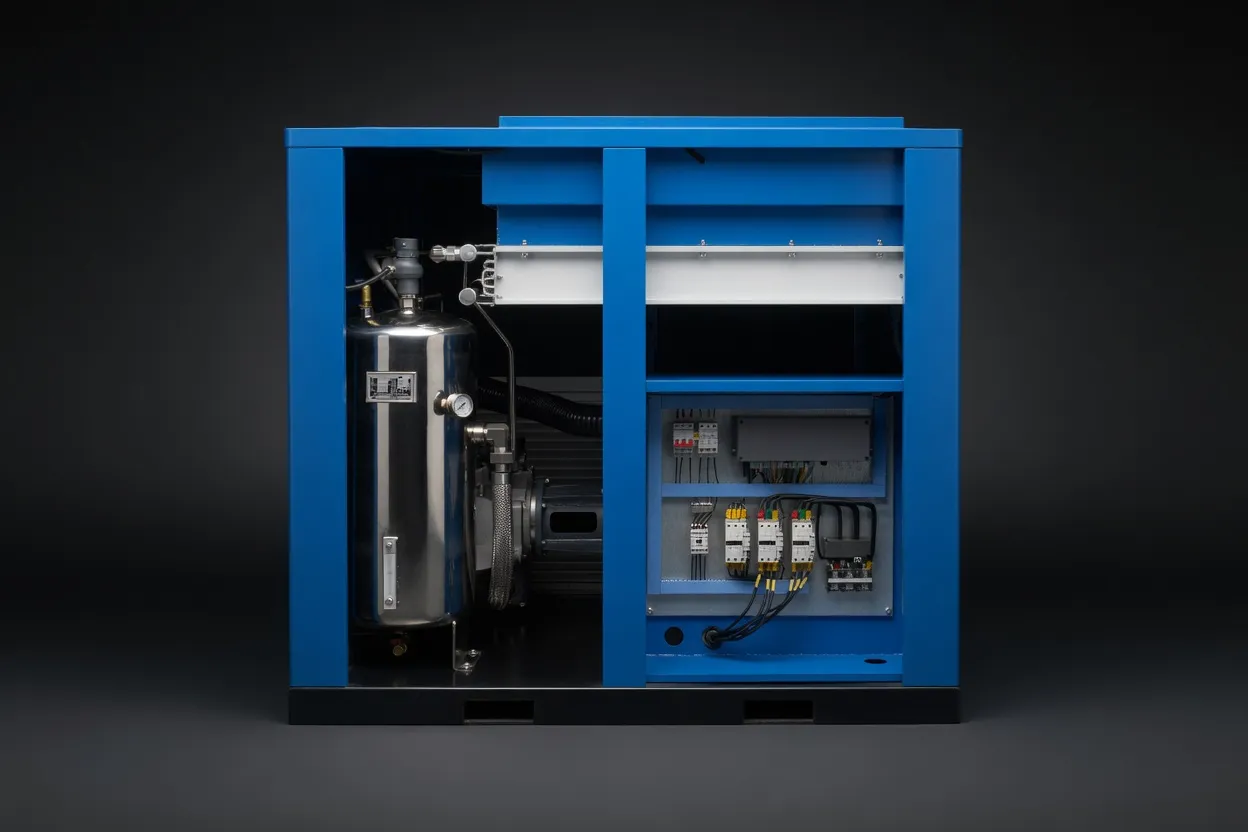
In a water-injected compressor, the water performs the intercooling internally, continuously, throughout the compression stroke. Temperature is controlled at the point of generation rather than removed after the fact. This is why water-injected machines reach 7–10 bar in a single compression stage — the temperature never rises to a level that demands a staged approach. Single-stage compression means fewer moving parts, a more compact machine, lower maintenance requirements, and a simpler installation. These are secondary benefits of near isothermal compression, not separate design choices.
How Water Injection Rate Affects the Degree of Isothermality
The quantity of water injected per unit of air compressed is not arbitrary — it is a precisely engineered parameter that determines how close the compression process comes to the isothermal ideal. Too little water and the temperature rises faster than the water can absorb, moving the process back toward adiabatic. Too much water and the liquid fraction in the compression chamber increases hydraulic losses — the energy penalty of compressing an incompressible liquid against the rotors rises faster than the temperature benefit. The optimal water injection rate for a given rotor geometry, operating pressure, and inlet temperature is determined through computational fluid dynamics modelling and validated by calorimetric testing on the physical machine. Leading manufacturers publish the water injection rate as a design parameter and hold it to specification through the water circuit control system. Understanding this balance helps explain why water quality matters so much: contaminated water changes the physical properties of the injection medium, altering the heat transfer coefficient and therefore shifting the compression process away from the design optimum.
Near Isothermal Compression and Air Purity: The Connection
Lower discharge temperature has a direct positive effect on compressed air quality, independent of the oil-free nature of the compression process. High-temperature compressed air carries more water vapour — the higher the temperature, the more moisture the air holds before condensation occurs. When dry oil-free compressors discharge at 200°C, the compressed air carries a very high vapour content that must be removed by large refrigeration dryers working close to their capacity limits. When water-injected oil-free screw compressors discharge at 70°C, the moisture load on the downstream dryer is significantly lower, allowing a smaller dryer to achieve the same outlet dew point specification. This reduces the capital cost of the dryer, reduces its energy consumption, and extends the service life of its components — all downstream consequences of the near isothermal compression process in the compressor element.
Frequently Asked Questions
Learn How Water Injection Can Reduce Your Energy Bill
Contact Hangzhou Ever Power for a specific energy comparison between your current compressor and our water-injected oil-free models.
Hangzhou Ever Power Air Compressor Co., Ltd. · Shenhua Road, Hangzhou 310031 · +86 13083988828