
Why Compressed Air Quality Is a Food Safety Issue, Not Just an Equipment Decision
In food and beverage production, compressed air contacts the product directly — purging filling heads, conveying ingredients pneumatically, operating packaging seals, and blowing bottles clean before filling. A single contamination event from oil in the air stream can trigger a product recall, a regulatory inspection, and reputational damage that no insurance policy fully covers. This is why the question of which compressor to install is fundamentally a food safety decision first, and an engineering procurement decision second. The two main candidates for Class 0 oil-free performance in food plants are the oil-injected screw compressor with downstream filtration and the water-injected oil-free screw compressor that contains no oil anywhere in the compression cycle. Understanding where each genuinely stands — not where the brochure claims it stands — is the starting point for a defensible purchasing decision.
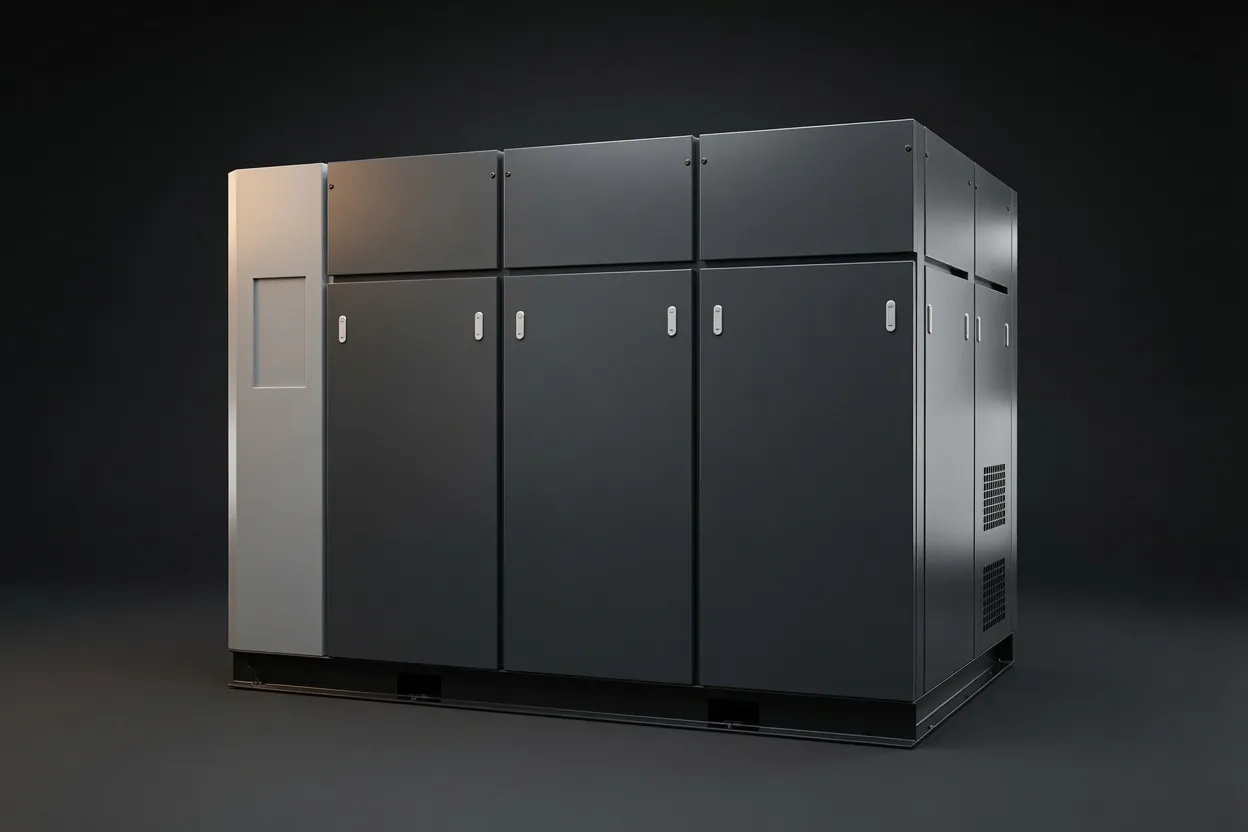
How Oil-Injected Compressors Handle Food-Grade Air — and Where the Risk Sits
An oil-injected rotary screw compressor uses lubricating oil inside the compression chamber to seal rotor clearances, cool the compression process, and lubricate the rotor surfaces. Oil is then separated from the compressed air in a coalescing separator and returned to the lubrication circuit. The compressed air leaving the separator still contains residual oil aerosol at concentrations typically between 2–5 mg/m³. To reach ISO 8573-1 Class 0 oil content (which requires oil so low it falls below standard instrument detection limits), the air must pass through a high-efficiency coalescing pre-filter, then an activated carbon adsorber to remove oil vapour, and in some installations a second coalescing stage. Each filter stage is a consumable component that degrades, saturates, and eventually fails — and when it does, without a downstream oil detector and automatic shutdown, the food product receives contaminated air until someone notices.
This filtration chain is technically sound when properly maintained and monitored. The weakness is the maintenance dependency. Carbon adsorbers have a finite service life that varies with oil carry-over concentration, air temperature, and throughput. In a busy food plant where maintenance resources are stretched across dozens of systems, the compressor room oil filters are not always the highest priority. Audits of food plants regularly find carbon adsorbers used significantly beyond their rated service life, coalescing filters with differential pressure alarms bypassed, and no oil monitoring at the point of use. These are not hypothetical failure modes — they are the actual failure modes that have caused food contamination incidents.
How Water-Injected Compressors Eliminate the Oil Risk at Source
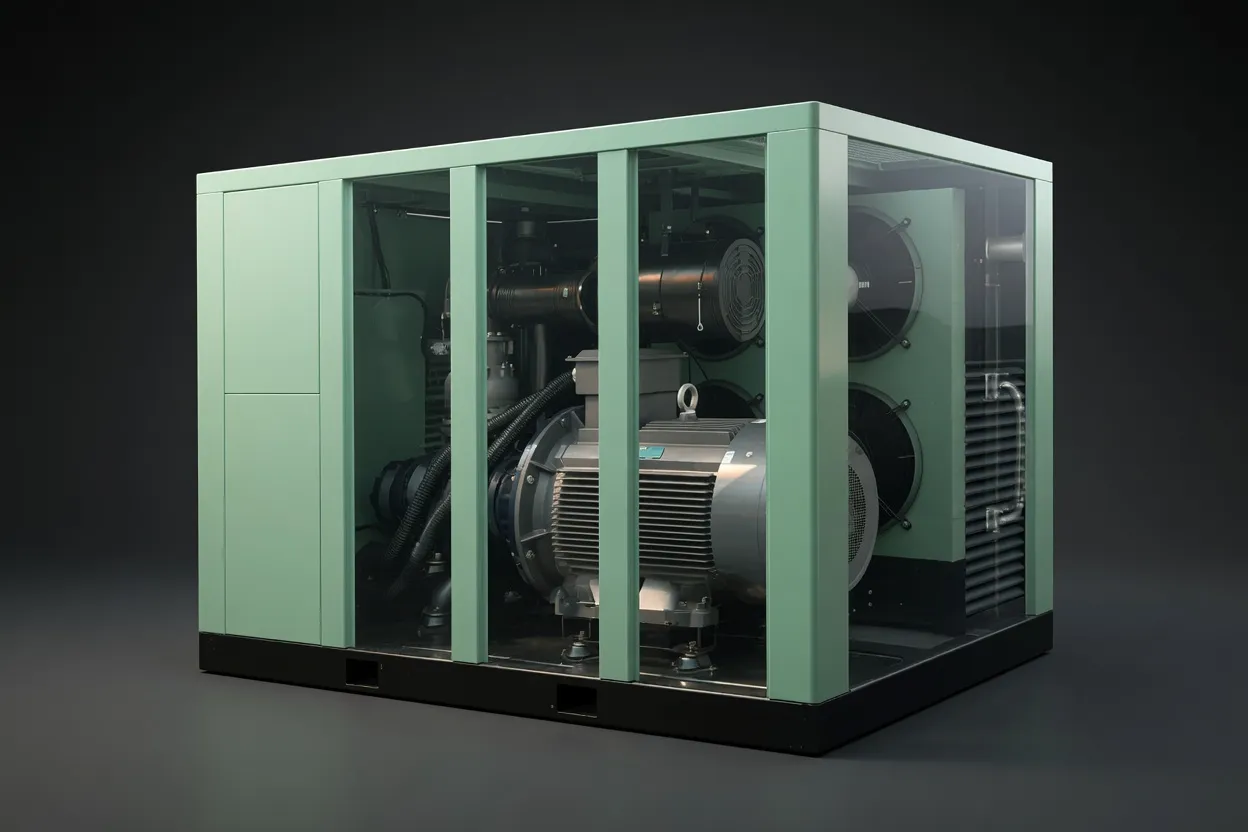
A water-injected oil-free screw compressor contains no lubricating oil anywhere in the compression system. Water — purified by reverse osmosis to below 50 µS/cm conductivity — is injected into the compression chamber, where it simultaneously cools, seals, and lubricates the rotor surfaces. It separates from the compressed air downstream, is cooled, filtered, and re-injected in a closed loop. There is no oil-based contamination pathway. The compressed air at the package outlet does not require a carbon adsorber stage because there is no oil vapour to adsorb. High-efficiency particulate and moisture filtration are still required to achieve Class 0 particulate and dew point ratings, but the oil contamination risk is eliminated at the source rather than captured downstream after it has already entered the air stream.
For food safety auditors and quality managers, this distinction carries real weight. When a water-lubricated oil-free screw air compressor is installed, the compressed air system HACCP plan does not need to include a Critical Control Point for oil contamination from the compressor — because no oil exists to control. This simplifies the food safety management system, reduces the number of mandatory monitoring checks, and removes an entire category of nonconformance risk from the HACCP documentation.
Direct Comparison for Food and Beverage Applications
| Food Plant Criterion | Water-Injected Oil-Free | Oil-Injected + Filtration |
|---|---|---|
| Oil contamination at source | None — no oil in system | Present — removed by filters |
| Filter failure consequence | Particulate / moisture risk only | Oil enters product air stream |
| HACCP CCP for oil | Not required | Mandatory |
| Carbon adsorber needed | No | Yes — regular replacement |
| FDA / BRC audit readiness | Straightforward documentation | Filter records mandatory |
| Energy consumption | Lower by 10–18% | Higher baseline |
| Water quality management | Required (RO system) | Not required |
The Energy Cost Advantage That Changes the Business Case
Food and beverage plants typically run compressed air systems 24 hours a day, often across multiple shifts and weekend production runs. Energy cost is the dominant operating expense for compressed air — typically accounting for 70–80% of total lifecycle cost. Water-injected screw compressors deliver compressed air at 10–18% lower specific energy consumption than oil-injected machines at equivalent flow and pressure, because near-isothermal single-stage compression requires less work than the adiabatic multi-stage compression of an oil-injected machine. On a 132 kW compressor running 7,000 hours per year at a modest electricity rate, a 15% energy saving translates to a meaningful annual operating cost reduction. Over the typical 15-year service life of an industrial compressor, this cumulative saving dwarfs the original purchase price premium of the water-injected machine over its oil-injected alternative.
Regulatory Standards That Apply to Food Plant Compressed Air
Food plant compressed air quality is governed by multiple overlapping standards. Understanding which applies to your facility type and export markets determines the minimum specification your compressor system must meet.
International reference standard for compressed air purity. Class 0 = oil content below detection limit. Required for direct product contact applications.
Requires compressed air contacting food to be monitored, with records maintained. Water-injected systems significantly simplify BRC audit documentation.
US regulation requiring compressed air used in food contact to be free of oil and contaminants. Zero oil at source satisfies this requirement directly.
Require HACCP-based control of compressed air quality. Oil-free technology at source reduces the number of Critical Control Points requiring active monitoring.
Frequently Asked Questions
Specify Oil-Free Air for Your Food or Beverage Plant
Contact Hangzhou Ever Power to discuss your food plant air requirements. We supply ISO 8573-1 Class 0 certified water-injected oil-free screw compressors with full food-grade documentation.
Hangzhou Ever Power Air Compressor Co., Ltd. · Shenhua Road, Hangzhou 310031, China · +86 13083988828